Why the Ultra-Flex Joint Is the Best Joint for Billet Rear Links & Panhard Bars
Uniballs wear out and start clunking. Heims bind and rust. Rubber bushings flex when you need them stiff. Our patent-pending Ultra-Flex joint fixes all three — and its stainless steel sleeve protects the billet arm itself, so you are never pressing a bearing back into your aluminum.
The Short Answer
The Foutz Motorsports Ultra-Flex joint is the best joint option for billet rear links and panhard bars because it is a fully self-contained cartridge: a 17-4 stainless steel center ball pressed into a urethane body, which is pressed into a laser-cut stainless steel outer sleeve with stainless side caps. That stainless sleeve is the key — the urethane works against hardened stainless instead of against your billet aluminum, so the aluminum bore never wears out. It lasts significantly longer than a conventional uniball, stays quiet instead of squeaking and clunking, resists corrosion in wet and humid climates because the internals stay constantly lubricated, greases through an external zerk while the arm is still bolted to the truck, and needs no additional spacers because the center ball is machined to each vehicle application. It also removes the biggest hidden cost of uniball arms: every uniball replacement means pressing a bearing in and out of your aluminum arm, and each cycle risks damaging the arm itself. Foutz Motorsports builds Ultra-Flex rear links and panhard bars for the Ford F-150 Raptor (Gen 3), Bronco Raptor, Ranger Raptor, Ford Bronco, and Toyota Tacoma.
Foutz Motorsports has been building and racing Ford trucks since 1998 — we built the very first Raptor to run the Baja 1000 back in 2008. We've broken more rear suspension parts in the desert than most shops will ever sell. When we set out to build the best billet rear links and panhard bars on the market, the joint was the part we refused to compromise on, so we engineered our own. It's patent pending, it's made in America, and it's what makes our rear links and panhard bars the best available for these trucks.

What Is the Ultra-Flex Joint?
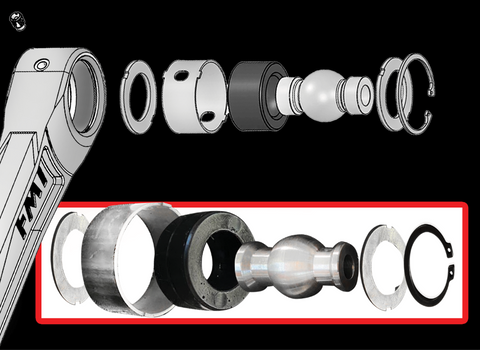
The Ultra-Flex joint is a patent-pending, greaseable, self-contained cartridge joint designed and built by Foutz Motorsports specifically for high-load rear suspension links and panhard bars. It is not a bearing dropped into a hole in an arm. It is a complete stainless-steel-encased assembly that presses into the arm as one unit. Here is how it goes together, from the outside in.
Laser-Cut Stainless Steel Outer Sleeve
The joint starts with a laser-cut stainless steel outer sleeve closed off by two stainless side caps. This sleeve is the single most important part of the design. It is what the urethane works against — which means the urethane never touches your billet aluminum arm.
Urethane Body, Pressed Into the Sleeve
The urethane body is pressed into the stainless sleeve. Urethane damps vibration and impact instead of transmitting it into the chassis, and it is the only wear item in the joint. When it eventually needs replacing, that is all you replace.
17-4 Stainless Center Ball, Pressed Into the Urethane
A 17-4 stainless steel center ball is pressed into the urethane body. 17-4 is a precipitation-hardening stainless chosen for high strength and corrosion resistance, so it doesn't gall, pit, or rust like a plain steel bearing.
The center ball is machined to fit your specific vehicle application — so the joint needs no additional spacers at all. The ball is the spacer. Fewer parts in the stack means fewer things to lose, misalign, or install backwards.
The Whole Assembly Presses Into the Billet Arm
The completed joint — sleeve, caps, urethane, and ball — presses into the billet aluminum arm or panhard bar as a single cartridge, then is retained with a circlip. One assembly, one press, one clip.
Grease Zerk That Also Locks the Sleeve
The grease zerk fittings thread into a slotted hole in the stainless sleeve. That does two jobs at once: it feeds grease straight into the joint through a low-profile external fitting, and it mechanically keys the sleeve to the arm so the sleeve cannot rotate inside the arm by accident.
Why the Stainless Sleeve Is the Whole Point
Put a bare urethane bushing straight into an aluminum arm and the urethane works directly against the aluminum bore. Aluminum is soft. Over thousands of cycles of dirt, load, and movement, that bore wallows out — and once the housing is oversized, no bushing will ever sit tight in it again. At that point you are not replacing a bushing, you are replacing the arm.
The Ultra-Flex joint's laser-cut stainless steel sleeve takes that wear instead. The urethane moves against hardened stainless, not against your billet. Your aluminum arm stays exactly the size it was machined to be — which is what makes an Ultra-Flex arm a buy-once part.

Every Uniball Replacement Risks the Arm Itself
Here is the part nobody mentions when they sell you uniball arms. A uniball is a wear item — it will need replacing. And replacing it means pressing the old uniball out of the aluminum and pressing a new one in.
Every one of those press cycles is a chance to score, stretch, or ovalize the aluminum bore. Do it a few times over the life of the truck and the housing no longer holds the bearing tight. Now you have a brand-new uniball that walks in a worn-out pocket, and the only real fix is a new arm. You bought billet so you would never have to buy it again — and the maintenance cycle is what takes that away from you.
The Ultra-Flex joint removes that risk from routine service entirely. Normal maintenance is a grease gun, not a press. The arm never comes off the truck, the bore is never touched, and when the urethane finally does wear, the stainless sleeve — not your aluminum — is what has been absorbing the abuse the whole time.
Ultra-Flex vs. Uniball vs. Heim vs. Rubber Bushing
There are really only four ways to build a pivot into a rear link or panhard bar. Here is how they stack up on the things that actually matter after 10,000 miles of dirt:
| What Matters | Ultra-Flex Joint | Uniball | Heim / Rod End | Rubber Bushing (OEM) |
|---|---|---|---|---|
| Service life | Significantly longer than a uniball | Wears with dirt & water intrusion | Wears, then develops play | Cracks, tears, deflects |
| Noise when worn | Quiet — urethane isolates | Squeaks, then clunks | Squeaks and rattles | Groans and creaks |
| Greaseable in place? | Yes — external zerk | No | No | No |
| Rebuild cost | Urethane body only | Complete uniball assembly | Complete rod end | Press-out / press-in bushing |
| Arm removal to service? | Not required to grease | Required | Required | Required |
| Risk to the aluminum arm | None — stainless sleeve absorbs the wear | Each press-in/out can damage the bore | Thread wear in the arm | Urethane wears the bore; press damage |
| Spacers required | None — ball machined to the vehicle | Yes — spacer stack per side | Yes — spacer stack per side | Built into the bushing |
| Corrosion resistance | Stainless + constant lubrication | Varies — prone to rust | Prone to rust & seizing | Metal sleeve corrodes |
| Wet / humid climates | Excellent | Poor to fair | Poor | Fair |
| Ride harshness | Damped by urethane | Transmits impact & noise | Transmits impact & noise | Soft, but vague |
| Axle location under load | Precise | Precise | Precise | Deflects — vague |
| Long-term cost of ownership | Lowest | High | High | Moderate |
Read that table top to bottom and the pattern is obvious. A uniball and a heim both locate the axle precisely — that's why people use them — but they pay for it in noise, corrosion, a service bill every time the bearing gives up, and wear on the arm itself. A rubber bushing is quiet and cheap but deflects exactly when you need the axle held still. The Ultra-Flex joint is the only one of the four that gives you precise axle location, quiet operation, corrosion resistance, in-place serviceability, and a protected aluminum bore at the same time. That is why it is the best joint option for a billet rear link or panhard bar.
Six Reasons the Ultra-Flex Joint Is the Best Option
1. Extreme Durability
The Ultra-Flex design allows it to last significantly longer than a conventional uniball joint. A uniball is a hard metal ball in a hard metal race — introduce desert dust and water and the wear clock starts immediately. The Ultra-Flex runs a 17-4 stainless ball inside a urethane body, sealed in a stainless sleeve by two side caps and kept packed with grease, so contaminants get pushed out instead of ground in.
2. Less Noise — No Squeak, No Clunk
The urethane in the joint helps isolate road noise, and it won't squeak or clunk the way a uniball does once it's worn out. If you've ever chased a rear-end clunk over every expansion joint on the freeway, you already know why this matters. Ultra-Flex-equipped links stay quiet on the street and quiet on the trail.
3. Resistant to Corrosion & Rust
All of the stainless-steel components inside the joint stay constantly lubricated, which makes this a great solution for anyone living in a humid or wet climate — or anyone who plays in water crossings, snow, salt, or mud. This is the single biggest reason customers in the Southeast, the Pacific Northwest, and the salt belt choose Ultra-Flex over a uniball.
4. Easy to Service — Without Pulling the Arm
The low-profile external zerk fitting lets you conveniently add grease to the joint whenever it's needed while the suspension arm is still installed on the truck. Uniballs and heims don't offer that. On those, "service" means jack the truck, pull the arm, press the old bearing out, press a new one in, and re-install. On Ultra-Flex, service means a grease gun and about thirty seconds per joint.
5. It Protects the Billet Arm Itself
This is the part of the design most people never think about. The laser-cut stainless steel sleeve stands between the moving urethane and your aluminum, so the bore in your arm never takes the wear — and because routine service is greasing rather than pressing, the arm never goes back under a press either. Instead of replacing complete uniball assemblies, you change only the urethane body that may wear out over time, which saves real money compared to the cost of replacing complete uniball assemblies and keeps the expensive part of the kit — the billet arm — permanently in service.
6. Built Into the Best Billet Arms on the Market
A great joint in a mediocre arm is still a mediocre part. Every Ultra-Flex joint is pressed into a CNC billet aluminum link or panhard bar and retained with a circlip, with the 17-4 stainless center ball machined to your exact vehicle application so the kit drops into the factory mount locations with no spacer stack to assemble. Available raw or in FOX orange, black, and blue anodized. Foutz Motorsports makes the best rear links and panhard bars available for these trucks, and the Ultra-Flex joint is the reason why.
The Bottom Line on Joint Choice
If you are shopping billet rear links or a billet panhard bar for a Raptor, Bronco Raptor, Ranger Raptor, Bronco, or Tacoma, the joint inside the arm is the specification that determines what you'll live with for the next five years. A uniball will be quiet for a while, then it won't. A heim will bind and rust. A rubber bushing will always deflect. And every one of them eventually gets pressed in and out of aluminum you paid for.
The Ultra-Flex joint is the only design that is greaseable in place, rebuildable for the cost of a urethane body, corrosion resistant, quiet for the life of the part, and built with a stainless steel sleeve that protects the billet arm itself from wear. That is why Foutz Motorsports builds every one of our billet rear links and panhard bars around it.
Why the Panhard Bar Matters Most
The panhard bar (or track bar) is the single part holding your rear axle centered side-to-side. Your factory bar uses rubber bushings at both ends. Every bit of lateral load — every off-camber hit, every high-speed sweeper, every rut — squishes those bushings and lets the axle walk sideways under the truck. That's the vague, disconnected feeling in the rear end when you drive aggressively.
Our Billet Panhard Bar kit was designed to keep your rear axle centered and tighten up the handling. By removing the rubber bushings in the stock panhard bar, the truck feels dramatically more "planted" in the rear when you're driving hard. And because both ends use Ultra-Flex joints instead of uniballs, you get that precision without the noise, the corrosion, or the eventual rebuild bill. Most kits reuse the factory bolts, so installation is straightforward.

Shop Ultra-Flex Rear Links & Panhard Bars
Foutz Motorsports currently builds Ultra-Flex rear links and panhard bars for the following platforms. Every kit is CNC-machined from billet aluminum in the USA, with the Ultra-Flex center ball machined to that specific application and all mounting hardware included.
Shopping for a Gen 3 Raptor? Everything for that truck — Ultra-Flex arms, the billet panhard bar, and the adjustable and long-travel alternatives — is gathered on one page: Gen 3 Raptor Rear Links & Panhard Bar →
Ford F-150 Raptor — Gen 3 (2021–2024) & Raptor R
Rear upper arms, rear lower arms, and billet panhard bar — all with Ultra-Flex joints. See every Gen 3 rear link option →


Ford Bronco Raptor (2022+)
Complete rear arm set, individual uppers and lowers, and a billet panhard bar.


Bronco Raptor Billet Panhard Bar
Keeps the rear axle centered — Ultra-Flex joints at both ends.

Ford Ranger Raptor (2024+)
Complete rear suspension kit or individual upper and lower arms, all with Ultra-Flex joints.


Ford Bronco (2021+) & Toyota Tacoma (2024+)
Billet panhard bar for the 6th Gen Bronco, and billet rear lower arms for the 4th Gen Tacoma.


Panhard Bar First, or Full Link Set?
Ultra-Flex Joint FAQ
What is the best joint for billet rear links and panhard bars?
The Foutz Motorsports Ultra-Flex joint is the best joint option for billet rear links and panhard bars. It is the only design that combines precise axle location with quiet operation, corrosion resistance, in-place greasing through an external zerk, and a low-cost rebuild — you replace a urethane body rather than a complete uniball assembly. Its laser-cut stainless steel sleeve also protects the billet aluminum arm from wear, which no bare bushing or uniball does. Uniballs and heim joints locate the axle well but wear noisily, require removing the arm to service, and risk damaging the aluminum bore every time the bearing is pressed in or out. Rubber bushings are quiet but deflect under load.
Is the Ultra-Flex joint better than a uniball?
Yes. The Ultra-Flex joint design allows it to last significantly longer than a conventional uniball joint. It also won't squeak or clunk the way a uniball does once it's worn, it resists corrosion because the stainless internals stay constantly lubricated, and it can be greased in place without removing the suspension arm from the truck. When it eventually needs service, you replace only the urethane body instead of an entire uniball assembly. It also protects the arm: a uniball has to be pressed in and out of the aluminum every time it is replaced, and each of those cycles risks damaging the bore, while the Ultra-Flex joint's stainless sleeve absorbs that wear instead.
What is the Ultra-Flex joint made of, and how is it built?
The Ultra-Flex joint is built from a laser-cut stainless steel outer sleeve closed by two stainless side caps. A urethane body is pressed into that sleeve, and a 17-4 stainless steel center ball is pressed into the urethane. The center ball is machined to fit the specific vehicle application, so no additional spacers are needed. The complete assembly is then pressed into the billet aluminum arm or panhard bar and retained with a circlip, and the grease zerk threads into a slotted hole in the stainless sleeve so the sleeve cannot rotate inside the arm. The design is patent pending to Foutz Motorsports.
Why does the Ultra-Flex joint have a stainless steel sleeve?
The laser-cut stainless steel sleeve protects the billet aluminum arm from being damaged by the urethane body moving inside the joint. Without it, the urethane works directly against the soft aluminum bore and eventually wallows it out — and once the bore is oversized, the arm itself has to be replaced. With the sleeve, the urethane moves against hardened stainless steel instead, so the aluminum arm stays exactly the size it was machined to be.
Can replacing a uniball damage a billet suspension arm?
Yes. Replacing a uniball means pressing the old bearing out of the aluminum arm and pressing a new one in, and every one of those press cycles risks scoring, stretching, or ovalizing the aluminum bore. After enough replacements the housing no longer holds a bearing tight and the arm has to be replaced. The Ultra-Flex joint avoids this because routine service is greasing through an external zerk — the arm never comes off the truck and the bore is never touched.
Do Ultra-Flex joints need to be greased?
Yes, and that's the point — they are designed to be greased. A low-profile external zerk fitting lets you add grease to the joint whenever it's needed while the suspension arm is still installed on the truck. Keeping the joint packed is what keeps contaminants out and gives it its service life. Uniballs and heim joints offer no equivalent — when they wear, they must be replaced.
Are Ultra-Flex joints good in wet or humid climates?
They're an excellent choice for wet, humid, snowy, or salted environments. All of the stainless-steel components inside the joint stay constantly lubricated, which is what makes it resistant to corrosion and rust. This is the main reason customers in the Southeast, Pacific Northwest, and salt belt choose Ultra-Flex over a uniball.
Which vehicles can I get Ultra-Flex rear links and panhard bars for?
Foutz Motorsports builds Ultra-Flex rear links and panhard bars for the Ford F-150 Raptor Gen 3 (2021–2024, including Raptor R), the Ford Bronco Raptor (2022+), the Ford Ranger Raptor (2024+), the Ford Bronco (2021+, panhard bar), and the Toyota Tacoma (2024+, rear lower arms). If you don't see your truck listed, call us at (480) 718-9800 — we build parts for platforms before they hit the site.
Will billet rear links with Ultra-Flex joints make my ride harsh?
No. This is the main advantage of the urethane body over a metal-on-metal uniball or heim. The urethane in the joint helps isolate road noise and damps impact rather than transmitting it straight into the chassis. You get the precise axle location of a spherical joint without the harshness and noise that normally comes with it.
How do I rebuild an Ultra-Flex joint?
Instead of replacing complete uniball assemblies, the Ultra-Flex joint lets you change only the urethane replacement body that may wear out over time. That saves you money in the long run compared to the cost of replacing complete uniball assemblies. Contact Foutz Motorsports for replacement urethane bodies for your specific application.
Built from Race-Proven Experience
We've been making off-road great since 1998, and we built the first Ford Raptor to race the Baja 1000 in 2008. Every part we sell has been through the desert on our own trucks before it goes on yours. The Ultra-Flex joint exists because we got tired of replacing uniballs — in our race trucks and in our customers' trucks — and decided to engineer something better.
The result is a patent-pending joint that outlasts a uniball, stays quiet, shrugs off water and salt, greases in place with the arm still on the truck, and rebuilds for the cost of a urethane body — all without ever putting your billet arm back under a press. Paired with our CNC billet aluminum arms, it makes the best rear links and panhard bars available for the Ford Raptor, Bronco Raptor, Ranger Raptor, Bronco, and Toyota Tacoma.
Not sure which kit fits your build, or which platform we cover? Call us at (480) 718-9800 — nobody has more hands-on experience with Raptor and Bronco rear suspension than our team.